The obvious assumption is that a children’s water bottle is an adult bottle scaled down. Smaller capacity, maybe a brighter color, same basic design. That’s how a lot of products in this category are actually made, which is why a lot of them don’t work particularly well for kids. The ones that do work are designed differently from the ground up — not just in size, but in how every functional element accounts for the specific ways children interact with objects, the safety requirements that apply to products for kids, and the fact that a bottle a child won’t use is a bottle that wasn’t worth buying.
Here’s what the meaningful design differences actually are and why they matter.
Ergonomics for Smaller Hands
An adult holds a bottle with a full hand wrapped around it. A young child holds a bottle with fingers that may not reach around the circumference, using a grip that’s less stable and more dependent on surface texture and shape than an adult grip.
The practical consequence of this is that bottle diameter matters more for kids’ products than for adult products. A bottle designed for a seven-year-old needs to be narrow enough to grip securely with a small hand — not so narrow that capacity is severely limited, but not adult-diameter either. Most well-designed children’s bottles in the 350-500ml range land at a diameter that works for the target age because the manufacturers have tested grip by age group rather than just scaling down the visual proportions.
Weight is the other ergonomic factor. A 500ml insulated stainless bottle designed for adults weighs significantly more empty than a well-designed children’s bottle of similar capacity because the wall thickness and material volume are calibrated for adult use durability rather than for a product a child will carry all day. Children’s bottles that are too heavy to carry comfortably when full get left behind or set down rather than used — which is the opposite of the intended function.
Wrist straps and carry loops are features that appear on children’s bottles more consistently than on adult products for exactly this reason. A bottle that can be looped to a backpack or carried on a wrist is one that actually makes it from home to school and back.
Lid Design: The Open-Without-Help Problem
The single most important functional difference between a children’s water bottle and an adult one is whether a child can open it independently. This seems obvious but is routinely underweighted in product design and purchasing decisions.
A flip-top lid that requires more than about 1kg of force to unlatch is a lid that many young children can’t open reliably. That means asking a teacher or parent every time they want a drink, which means drinking less than they should throughout a school day. The force required to open a lid is rarely specified in product listings, and it’s something that varies widely across products in the same category.
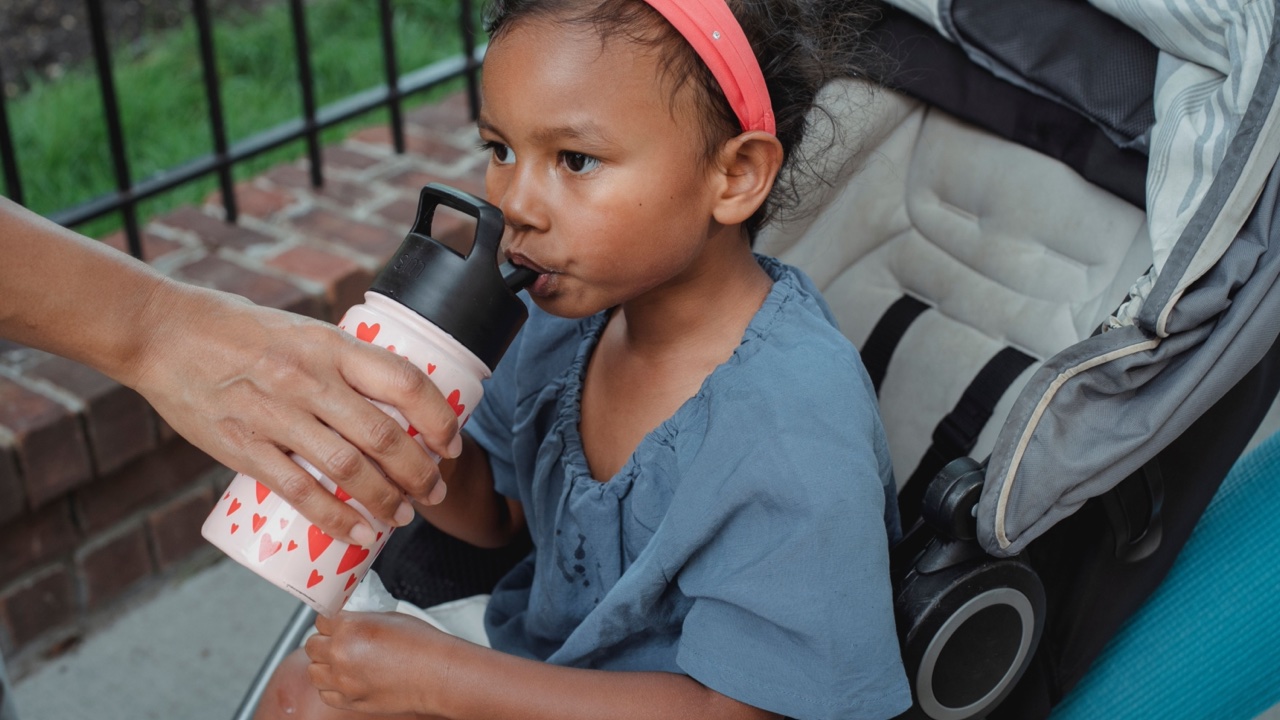
Straw lids are popular for younger children partly because they eliminate the need to tip the bottle. A bite valve straw that a child can simply sip from without manipulating a lid mechanism significantly lowers the bar for independent use. The tradeoff is that straw components have more parts that need cleaning and more potential failure points — particularly the bite valve, which can develop a sticky action or begin to leak with age.
Wide-mouth lids with a simple screw cap are easy to open in terms of force required but require two hands and produce spills if the bottle is tipped. They work better for older children who have more hand strength and coordination than for the four-to-seven age range where independent lid operation matters most.
The parent preference in this category tends to be for lids that are easy for the child to open but spill-resistant when closed — a combination that requires more engineering than either property alone.
Safety Certifications: Different Requirements, Not Just Adult Standards
Products marketed specifically for children face more stringent regulatory scrutiny than equivalent adult products in most markets, and the material requirements are tighter.
In the US, children’s products must meet CPSC (Consumer Product Safety Commission) requirements. For drink containers, this includes compliance with lead content limits that are stricter than those for adult products, phthalate restrictions for any plastic components, and BPA-free status. The CPSC’s Children’s Product Certificate requirement means that compliance must be documented and tested by an accredited third-party laboratory, not just claimed by the manufacturer.
In the EU, products intended for children must meet the general product safety requirements of the General Product Safety Directive, with specific attention to chemical migration limits for food-contact materials that account for children’s greater vulnerability to chemical exposure relative to body weight. The EN 71 toy safety standard is sometimes cited for children’s products even when they’re not toys, because it establishes recognized thresholds for heavy metal content and other chemical safety parameters.
For stainless steel bottles sold for children, the interior food-contact grade matters more than for adult products for the same reason — children typically consume more beverage relative to body weight than adults, so migration of any trace contaminants is proportionally more significant. 304-grade (18/8) stainless is the standard, but verifying that interior welds and manufacturing processes don’t introduce other materials is part of responsible sourcing for this category.
Color, Decoration, and the Engagement Factor
Children don’t drink from bottles because hydration is important. They drink from bottles because the bottle is in front of them, they’re thirsty, and the lid is easy to open. The role of design in this process is less about aesthetics and more about whether the bottle is something the child will actually carry and use.
Color psychology in children’s product design is reasonably well-studied. Younger children (roughly three to seven) respond most strongly to high-saturation primary and secondary colors — the appeal is immediate and instinctive rather than considered. Older children (eight and up) increasingly have preferences influenced by peer context and identity, which is why bottles for this age group often feature character licenses, sports team associations, or colors that read as “cool” within peer groups rather than simply bright.
For bulk purchasing — school programs, summer camps, sports clubs — the practical implication is that single-color runs in age-appropriate colorways work better than trying to please every individual preference. A bright blue or green with a clear logo placement is more useful at scale than attempting to accommodate the full range of individual preferences.
Character licensing adds cost but significantly increases voluntary uptake in the three-to-eight range. A child who chose their own bottle or was given one featuring something they care about is more likely to carry it and use it. This matters for institutions where hydration compliance is an actual goal rather than just a formality.
Capacity and What It Actually Needs to Cover
Children need less total fluid per day than adults, but the distribution of that need across a school day means the capacity question is more specific than it looks.
A child in school for six hours with recess and lunch needs to replace approximately 600-900ml of fluid during that time under normal conditions, more in hot weather or with significant physical activity. A bottle sized to cover that range without requiring a refill mid-morning tends to get used more consistently than one that’s empty by 10am or too large to finish.
The most common sizes in well-designed children’s products are 350ml (appropriate for young children, four to six years, half-day programs), 500ml (the most versatile size, covering most school-day needs for children six to ten), and 600-750ml (appropriate for older children, active use, or hot weather contexts).
Wider capacity claims — “holds 1 liter for all-day hydration” — often reflect adult use logic applied to a children’s product. A one-liter bottle is heavy when full, physically large relative to a child’s backpack, and takes up space that competes with books and lunch. The goal isn’t maximum capacity; it’s the right capacity that a child will actually drink from and carry without it becoming a burden.
What to Look For When Buying in Bulk
For schools, camps, clubs, and other institutions sourcing bulk kids water bottles, the evaluation criteria are somewhat different from individual parent purchasing.
Age-appropriateness of the lid mechanism is the most operationally important factor. A lid that requires teacher assistance defeats the purpose of providing individual bottles. Test samples with children in the target age range before committing to a quantity — what looks easy to open on a desk in an office is sometimes not easy to open with small hands.
Durability under institutional conditions is different from durability under home conditions. Bottles in schools get dropped, kicked, left in direct sunlight, put through dishwashers repeatedly, and occasionally thrown. The lid hinge and the bottle body both need to hold up to this treatment, and the only reliable way to assess it is either long-term testing or sourcing from a manufacturer with demonstrated institutional references.
Cleaning accessibility matters for hygiene at scale. A bottle with complex internal geometry or a straw mechanism with multiple components requires more careful cleaning and is more likely to accumulate residue in institutional contexts where thorough individual cleaning isn’t guaranteed. Simpler is more hygienic at scale.
The combination of these factors — not just unit price — determines whether a bulk bottle purchase actually achieves its purpose.